ONBOARDING FORM CONTROL
Verify the Current Onboarding Form Version
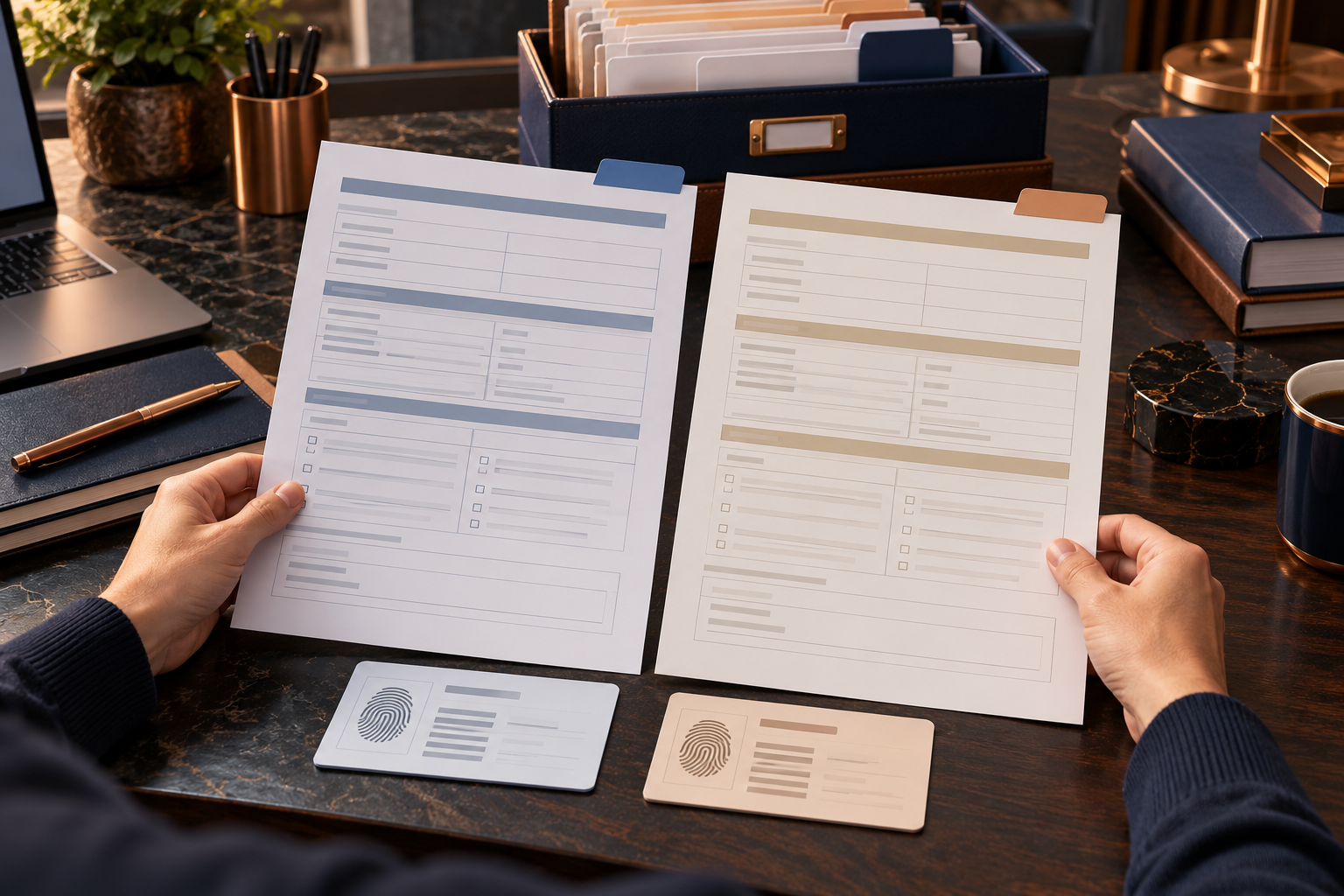
Use a compact release record to distinguish the approved template from drafts and copies.
01 / CONTEXT
Define the control decision
Staff need a reliable way to confirm that a blank form is current before sending it to a new hire. A version label alone is weak unless it maps to an owner, effective date, checksum or controlled release record.
Use a compact release record to distinguish the approved template from drafts and copies.
02 / PROCEDURE
Run the control sequence
- 01
Assign a human-readable release identifier.
- 02
Record filename, owner, effective date and storage path.
- 03
Keep comparison or checksum evidence outside the form.
- 04
Retire superseded copies from common-use locations.
- 05
Recheck links and instructions after each release.
03 / EVIDENCE
Preserve proof without personal data
A defensible control record identifies the form owner, approved filename, effective version, authoritative storage path, permitted editors, reviewer, backup evidence and next review date. It should not contain applicant, employee, payroll, tax, health or identity information. Use fictional fields during every technical test.
Recheck the arrangement after changes to Windows, storage, Folder Protect, permissions, staff roles or the form itself. Confirm both usability and recovery: an authorized user should reach the released template, an unauthorized account should not alter the master, and the recovery owner should restore the approved blank version without depending on the working folder. Preserve evidence of unexpected behavior instead of repeatedly changing controls.
Keep the claim narrow. Local restrictions can reduce accidental access or changes on a tested computer, but they do not determine employment policy, validate form wording, administer identities, provide e-signatures, create version history or replace backup. Escalate those requirements to the system and owner responsible for them.
During review, ask a second operator to follow the written procedure without verbal help. Record whether the person can identify the master, create the intended working copy, recognize the current release and find the recovery owner. This usability check reveals ambiguous filenames, hidden dependencies and undocumented knowledge before a real onboarding deadline. Correct the procedure, then repeat the test with a clean fictional form and retain only minimal, non-personal evidence.
04 / BOUNDARY
State what the control cannot prove
File restriction is not version control and cannot prove that two documents contain identical or approved content.
Validate the exact Windows account, storage path and current software release. If centralized workflow, immutable history, identity governance, legal retention or electronic signatures are required, select systems designed for those jobs rather than broadening a desktop-control claim.
05 / SOURCES
Primary references
References support specific controls and do not imply endorsement.